


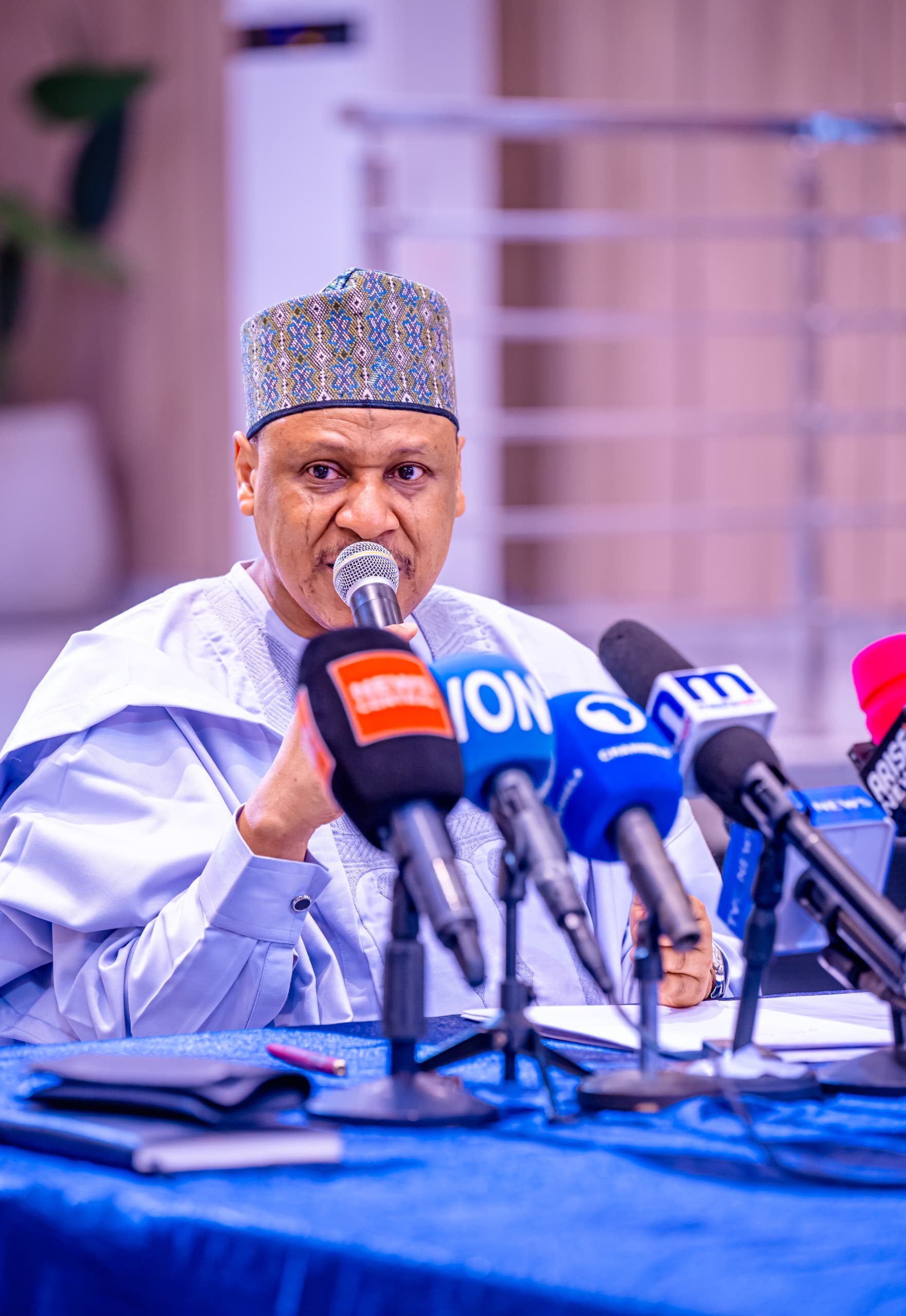
 Vice President Kashim Shettima has stated that the economic reforms being implemented by President Bola Tinubu’s administration must eventually result in more employment opportunities, stronger businesses, increased purchasing power and improved living conditions for Nigerians.
Shettima made the statement in a goodwill message presented at the 2026 All Nigeria Editors Conference in Enugu on Thursday. He called on the media to report on the government’s economic achievements while continuing to examine and hold its policies and actions to account.
His comments were made in line with the theme of the conference, “The Ballot, the Media and the Task of Keeping Democracy Alive,” and the sub-theme, “When Lies Look Real: Detecting and Debunking AI Disinformation Before, During and After Election.”
The Vice President, who did not attend the conference due to what he described as “other pressing responsibilities of state,” noted that Nigeria’s economy recorded a growth rate of 4.43 per cent in the second quarter of 2026, compared with 4.23 per cent during the same period in 2025.
However, he acknowledged that economic growth figures alone were not enough, noting that the administration’s ultimate goal was to ensure that macroeconomic improvements have a positive impact on the everyday experiences of Nigerians.
“Inflation has also moderated substantially from the levels recorded earlier in the reform period, although we recognise that the real test is what these improvements mean for the cost of living and the purchasing power of ordinary Nigerians.
“These numbers give us reason for confidence, but not for complacency.
“President Tinubu’s objective is clear: macroeconomic stability must translate into jobs, stronger businesses, greater purchasing power and a better quality of life for Nigerians. That work continues, and we are confident that, with sustained reforms, the trajectory can only get better,” Shettima said.
The Vice President’s comments framed the administration’s economic progress as going beyond GDP growth and other macroeconomic statistics, stressing that the true measure of the reforms would be their impact on the welfare of households.
The National Bureau of Statistics had reported that Nigeria’s real GDP grew by 4.43 per cent year-on-year in the second quarter of 2026, compared with 3.89 per cent in the first quarter of the year.
Shettima also appealed to editors to provide balanced coverage of the government’s performance, saying the media should report areas of progress while continuing to scrutinise those in power.
“As you scrutinise government, I also urge you to continue telling the full story of our country, including where progress is being made,” he said.
He maintained that disagreements between the government and the media were part of a healthy democratic process, stressing that journalism should remain guided by facts and responsibility.
“Government and the media will not always agree, nor should we.”
“Democracy is strengthened when disagreement is informed by facts, exercised responsibly and conducted in good faith. What must unite us is the greater Nigerian project,” he said.
Shettima also drew attention to the growing threat artificial intelligence poses to elections and the wider information environment.
According to him, the importance of professional journalism has increased as technological advancements make it easier to create and circulate convincing false information.
“When technology can manufacture convincing falsehoods at unprecedented speed, professional journalism becomes more important, not less.
“The editor remains a crucial gatekeeper between information and manipulation,” Shettima said.
He further noted that the media’s responsibility to safeguard democracy goes beyond coverage on election day, as journalists and editors are expected to scrutinise those in authority, provide citizens with reliable information and preserve the nation’s institutional memory.
“The ballot gives citizens a voice, but that voice can only be meaningful when citizens have access to credible information on which to make their choices,” he said.
Other speakers at the conference expressed similar concerns.
The Obi of Onitsha and chairman of the conference, Igwe Nnaemeka Achebe, described democracy as a system that requires constant protection. He warned that the quality of information available to citizens could determine whether they make electoral choices based on facts or falsehoods.
“The ballot is the citizen’s voice. The media is the mirror by which that citizen sees the world clearly enough to know what to say with that voice.
“When the mirror is cracked, or worse, deliberately distorted, the citizen no longer votes from truth but votes from illusion. And a democracy built on illusion is not genuine democracy but drama. It becomes a theatre,” Achebe said.
He urged editors to make verification an essential part of newsroom operations, particularly with the increasing difficulty of distinguishing AI-generated material from genuine content.
“In the old order, being first with the news was honour. In this new order, being first with a lie dressed as news is a betrayal of the public trust, however unintentional,” he said.
Achebe also called on journalists to apply consistent standards when dealing with misinformation, regardless of which political side may benefit from it.
“True journalistic integrity in this era will require you to correct falsehoods regardless of who benefits from them, before, during, and yes, after elections,” the monarch said.