

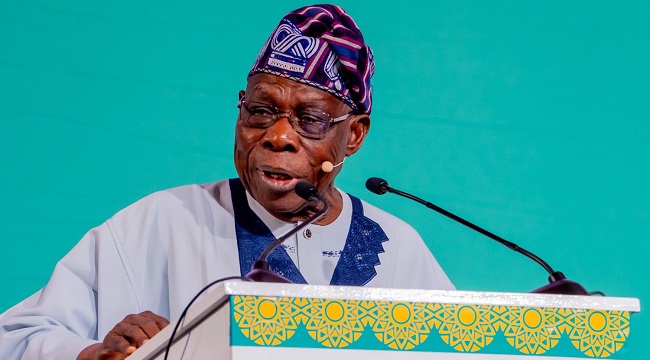
Former President Olusegun Obasanjo has warned that corruption places the greatest burden on the poor, saying illicit wealth undermines development and national progress.
Obasanjo made the remarks on Monday at the public presentation and launch of “Unexplained Wealth: A Trilogy of Nigerian Financial Law,” written by Senior Advocate of Nigeria, Dr Wahab Shittu, at the Oriental Hotel in Victoria Island, Lagos.
The former President, while reflecting on his long history of involvement in the fight against corruption, maintained that corruption and development cannot thrive together.
“Whichever way it is described, it is anti-social, it is anti-development, it is anti-progress. It is not in the best interest of any country or any human organisation,” he said.
Obasanjo said his commitment to combating corruption began during his military career, when he worked as a prosecutor under military law and participated in a court-martial involving corruption.
He explained that his anti-corruption activities became more pronounced after he left office as military head of state and took up farming, when Peter Eigen, a former World Bank official and later founder of Transparency International, approached him.
According to Obasanjo, Eigen contacted him based on his experience at the World Bank, where he had observed what he referred to as “grand corruption.”
“He came to me and said, ‘I want you to join me in fighting corruption.’ I had never met him in my life; I had never known him anywhere,” Obasanjo recalled.
He said Eigen explained that his experience at the World Bank had shown him how funds from loans provided to countries were diverted, leading to the establishment of Transparency International by both men.
Obasanjo said he became chairman of the organisation’s Advisory Council, while Eigen served as its chairman.
He recalled seeking the backing of Bob McNamara, a former United States Secretary of Defence and president of the World Bank, who initially told them their mission would be extremely difficult.
“He said, ‘You two are trying to do the impossible,’” Obasanjo recalled.
According to him, McNamara later pledged moral and financial backing if they were able to produce tangible results.
“He said to us, ‘I will promise you both moral and financial support when you show results,’” he said.
Obasanjo said he and Eigen subsequently travelled across Latin America, Asia and Africa to mobilise support for the anti-corruption organisation.
He explained that one of their early efforts focused on the Organisation for Economic Co-operation and Development, OECD, which at the time permitted companies to treat bribes paid as tax-deductible expenses.
“We then decided that the first thing we ought to do is to get OECD not to support money paid for corruption to be deducted for tax purposes,” he said.
Obasanjo said it took nearly three years of campaigning before the OECD discontinued the practice.
He added that the achievement contributed to greater recognition for Transparency International.
The former President also recalled his administration’s efforts to establish the Independent Corrupt Practices and Other Related Offences Commission.
He said Transparency International supplied him with a model anti-corruption law, which eventually served as the foundation for the legislation establishing the ICPC in Nigeria.
“I went to Transparency International, and they gave me a model of a law. And that law that became—or that brought about ICPC,” he said.
According to Obasanjo, the proposed legislation encountered opposition in the National Assembly, as some lawmakers expressed concern about its possible consequences.
“They said to me that if they pass the Bill as I gave it to them, most of them will end up in prison,” he said.
He said the lawmakers eventually took 18 months to pass the Bill.
Obasanjo added that he later established the Economic and Financial Crimes Commission to further strengthen Nigeria’s anti-corruption efforts.
“Then to strengthen it, I came up with the EFCC,” he said, attracting applause from the audience.
He also praised Nuhu Ribadu, whom he described as a “corruption fighter,” for his contribution to the EFCC from its early days.
Obasanjo said Shittu’s trilogy appropriately addressed three important areas in the fight against illicit wealth: law, prosecution and recovery.
He noted that strengthening these areas would assist societies in addressing unexplained wealth and illicit financial activities.
The former President said Nigeria had implemented anti-corruption measures even before the United Nations introduced a global framework on the issue.
“It took about three or four years for the global body, the global organisation, the United Nations, to propose and pass the anti-corruption framework and mandate each country to make laws against corruption. So, we were even ahead of the United Nations,” he said.
Obasanjo said his decision to accept the invitation to chair the book launch was based on his conviction that corruption remains a major impediment to development.
“When Wahab Shittu, SAN, the author, came to see me and invited me for this occasion, I gladly accepted.
“Because I know one big bane of development of any human organisation, and particularly of a country, one big handicap to development is corruption. Corruption and development are strange bedfellows; they don’t go together.”
He lamented that “Those who suffer most in the corrupt society are the poor. And it makes them poorer.”
Obasanjo stressed that Nigeria would struggle to achieve significant development if corruption continued to flourish.
He acknowledged that no country had completely eradicated corruption but said nations could prevent it from becoming deeply rooted in their systems.
“There’s nowhere in the world where corruption is totally eliminated. But there are many places in the world where corruption is not allowed to grow,” he said.
He called on Nigeria and other African countries to strengthen their legal frameworks and institutions while maintaining sustained efforts to combat corruption.
“We cannot make progress in our development as long as we allow corruption to lead,” he said.
Obasanjo congratulated Shittu on the publication, noting that works of such nature were important in sustaining efforts to combat corruption in Nigeria and across the African continent.